NEMA Publishes ANSI C136.29 Roadway and Area Lighting Equipment—Metal Halide Lamps–Guide for Selection

The National Electrical Manufacturers Association (NEMA) has published ANSI C136.29 Roadway and Area Lighting Equipment—Metal Halide Lamps–Guide for Selection.

This selection guide includes screwbase single-ended metal halide lamps that can be used in roadway and area lighting equipment.

The contents and scope of C136.29-2011 may be viewed here.

Product Monday: Granville II LED Luminaires by Holophane

GranVille® II LED luminaires from Holophane offer the same classic housing choices that made Holophane’s GranVille HID line popular and are offered with Classic or Premier prismatic borosilicate glass optics to facilitate use of new or installed pieces. These fixtures feature a new optical design that provides HID light levels while creating a comfortable wholly luminous appearance with low glare, less uplight and less light trespass. Multiple lumen packages are available and fixtures may be ordered with asymmetric or symmetric distributions. The luminaires are optimized to meet existing light standards. Click here to learn more.

DOE Approves Two-Year Extension for Energy Standards for 700 Series T8 Lamps

Department of Energy (DOE) regulations for general-service fluorescent lamps, which take effect July 14, 2012, strengthen standards established by the Energy Policy Act of 1992 while expanding coverage to include 8-ft. T8 lamps, 4-ft. T5 lamps and more wattages of 4-ft. T8 and T12 lamps. Aside from some exemptions, the regulations were expected to eliminate a majority of 4-ft. linear and 2-ft. U-shaped T12 lamps, many 8-ft. T12 and T12HO, and some lower-color-rendering 4-ft. T8 lamps.

As a result of the rare earth crisis, however, DOE recently granted a request by GE Lighting, Philips Lighting Company and OSRAM SYLVANIA to extend the effective date of the regulations for these companies’ lower-color-rendering 4-ft. T8 lamps by two years. The new effective date is now two years later, or July 14, 2014. This provides building owners a lower-cost option for applications where color rendering is less important, such as transition spaces, storage rooms and industrial applications.

Fluorescent lamps produce light through the process of fluorescence, in which electric current is passed through mercury vapor, resulting in the emission of UV radiation that is largely converted into visible white light by phosphors coating the lamp bulb. Application of rare earth phosphors, used in addition to or instead of traditional halophosphors, produce higher efficiency, color rendering and lumen maintenance. Five rare earth elements are used in phosphors for energy-efficient and high-color-rendering linear fluorescent lamps, primarily Yttrium, Europium and Terbium (which is why these lamps are sometimes called “triphosphor lamps”).

The problem is China currently controls more than 95 percent of the world’s supply. With demand increasing in recent years, China began limiting exports to ensure steady supply for its domestic industries, while increasing taxes and tariffs. As a result, prices skyrocketed—increasing at an annual rate of 400 and 500 percent respectively for Terbium and Europium oxides in 2011—forcing lamp manufacturers to announce a series of steep price increases for rare-earth phosphor lamps.

One manufacturer, OSRAM SYLVANIA, brought a halophosphor T8 lamp to market as a lower-cost option for building owners, but this product is expected to be discontinued July 14, 2012 as it does not comply with the fluorescent lamp regulations. By temporarily granting the lamp manufacturers’ request to exempt lower-color-rendering 4-ft. T8 lamps, building owners will enjoy another option suitable for some applications. These 700-series (color rendering index, or CRI, of 70+) T8 lamps contain 70 percent less phosphor content than 800-series (CRI of 80+) lamps. (For applications where color is important, a minimum of 80 CRI is recommended.)

A randomly selected 700-series product operates at 75 CRI and produces an initial 2,745 lumens, about seven percent less than a 2,950-lumen 800-series lamp, and 2,444 mean lumens, or 13 percent less than the same 800-series lamp (89 percent versus 95 percent lumen maintenance).

The increase in rare earth material prices is resulting in new sources being developed outside of China, but this will take time, and different mines do not yield the same quantities of various elements. According to the Department of Energy, Europium, Terbium and Yttrium will continue to see high risk to supply and cost uncertainty for the near future.

Top 10 States for LEED

Sq. ft. of space to earn LEED-certification in 2011

Per capita

District of Columbia

18,954,022

31.50

Colorado

13,803,113

2.74

Illinois

34,567,585

2.69

Virginia

19,358,193

2.42

Washington

14,667,558

2.18

Maryland

11,970,869

2.07

Massachusetts

13,087,625

2.00

Texas

50,001,476

1.99

California

71,551,296

1.92

New York

36,538,981

1.89

Minnesota

9,591,445

1.81

Electrical Contractor Magazine Publishes Article About Model Lighting Ordinance

The Model Lighting Ordinance (MLO), produced jointly by the Illuminating Engineering Society (IES) and the International Dark-Sky Association (IDA), provides a template for municipalities seeking to develop standards for responsible outdoor lighting. Specifically, the MLO addresses skyglow (light emitted up into the sky that obscures nighttime viewing of stars), light trespass (light emitted onto neighboring property), and glare (excessive brightness that impairs or disables vision).

Click here to read an article I contributed to Electrical Contractor Magazine that provides an introduction to the MLO.

ICC Announces Availability of New Green Code

A new model code for constructing and remodeling buildings is expected to make buildings more efficient, reduce waste, and have a positive impact on health, safety and community welfare. The 2012 International Green Construction Code (IgCC) will increase the energy-efficiency of structures, while providing direction and oversight of green design and construction, according to the International Code Council.

The 2012 IgCC was developed at public hearings with input from experts in code development and enforcement, architecture, engineering, building science, environmental advocacy, government, business, academia and the public. IgCC was developed with the American Institute of Architects (AIA) and ASTM International as the initial cooperating sponsors, and with the support of ASHRAE, the U.S. Green Building Council (USGBC) and the Illuminating Engineering Society (IES).

The IgCC offers flexibility to jurisdictions that adopt the code by establishing several levels of compliance, starting with the core provisions of the code, and then offering “jurisdictional requirement” options that can be customized to fit the needs of a local community. A jurisdiction can also require higher performance through the use of “project electives” provisions.

The code acts as an overlay to the existing set of International Codes, including provisions of the International Energy Conservation Code and ICC-700, the National Green Building Standard, and incorporates ASHRAE Standard 189.1 as an alternate path to compliance. The IgCC provides model code language that establishes a baseline for new and existing buildings related to energy conservation, water efficiency, site impacts, building waste, material resource efficiency and other sustainability measures. The IgCC will be updated alongside the other model codes developed through the Code Council’s open, transparent, and consensus-based code development process.

Click here to learn more and purchase a copy.

The SSL Future

LEDs are currently dominating product development in the lighting industry, but still only represent about 5-10% of luminaire sales, and only 1% of the installed base of lamps in the United States, as shown below. And most of that is traffic signals and exit signs. This is a sobering reminder that LED lighting is still a very young technology.

That being said, the future appears to belong to this light source, with the potential to reduce U.S. Lighting consumption by nearly half and reduce carbon emissions by 1.8 billion metric tons, according to the Department of Energy. DOE further predicts that LED will achieve a market share, expressed as demand for lumen-hours, of 10% by 2015, with the smallest gain being in the commercial building sector (5%) and the largest in outdoor stationary sector (29%). LED share is expected to increase to about 36% in 2020, 59% in 2025 and 74% in 2030, with the biggest long-term gains being in outdoor and residential lighting. Shown below in this graphic is the resulting change to the installed base of lamps in the country (expressed in terms of demand for lumen-hours), with LED expected to represent 50% of all installed lighting in the U.S. by 2030.

This growth is based on expectations that LED lighting will continue to improve in efficacy, service life and cost. Efficacy is expected to improve to 145 lumens/W by 2015, and then plateau at the technology’s theoretical limit of efficiency of about 200 lumens/W.

Indoor luminaire average life is expected to increase from 25,000 hours in 2010 to 44,000 hours in 2015, and 48,000-50,000 hours from 2020 to 2030, while outdoor luminaire average life, estimated at an average 50,000 hours in 2010, is expected to increase to 68,000 hours in 2015 and 73,000-75,000 hours from 2020 to 2030.

While efficacy and service life increase, initial cost is expected to decline from about $181 per kilolumen in 2010 to $41.81 in 2015 and $12.73 in 2030.

Sources: The 2010 U.S. Lighting Market Characterization Report and Energy Savings Potential of Solid-State Lighting in General Illumination Applications, both by the Department of Energy, download here

Product Monday: Cove-15 and Cove-16 by Litecontrol

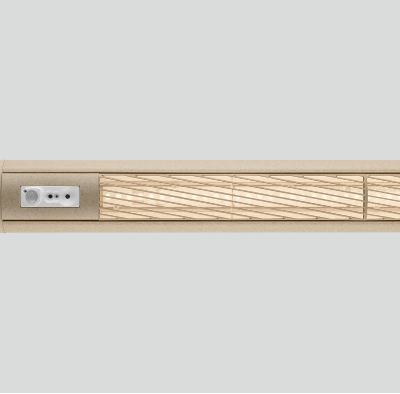
Litecontrol’s newest additions to the Concealed Cove family, Cove-15 and the surface-mounted Cove-16, are LED fixtures that represent the smallest cove luminaires in the family. Measuring only 1-1/2” high and 4-1/2” wide, both the Cove-15 and Cove-16“>Cove-16 offer replaceable LED modules, four color temperatures, three lumen and power choices and a five year warranty. The Cove-15 and Cove-16 have lenses that lie flat and are hidden from normal viewing angles, whereas most competitive product have lenses that are angled, increasing their visibility. These additions round out the company’s Cove Family which includes the Cove-25, available with T5 lamping and the Cove 30, available with T8 lamping.

Cove-15

Cove-16 surface mounted

Pure Edge Lighting’s Dallas Market Center Showroom

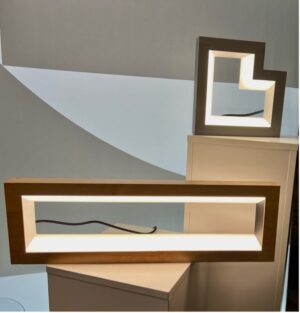
Pure Edge Lighting’s new showroom at the Dallas Market Center features LED products and innovative and artistic installations. Pure Lighting and Edge Lighting, both owned by Gregory Kay, recently merged to become distinct brands under the company Pure Edge Lighting. Due to growth, the company moved from a shared space to its own expansive showroom filled with new products and custom installations.

DOE Report Compares Life-Cycle Energy Consumption of LED Lamps with Incumbent Lighting Technologies

The discussion about LEDs as an energy and environmental cure-all has led to some skepticism about whether LEDs are truly big energy-savers and green when one considers the total lifecycle energy and environmental cost of the product, including manufacturing and transportation. To its credit, DOE took this seriously enough to commission a study. The first report, dealing with lifecycle energy consumption for replacement lamps, was recently published: Review of the Life-Cycle Energy Consumption of Incandescent, Compact Fluorescent, and LED Lamps. The second report will address luminaires as well, and also incorporate environmental impacts.

The first report, based on existing lifecycle assessment literature of lighting products, shows that as one might expect, most energy for a lamp is consumed during its actual use. DOE estimates that about 90% of total lifecycle energy consumption occurs during use, while 7-9% occurs during manufacturing and less than 1% during transportation. The study also found that, based on DOE’s assumption that the average LED lamp provides service life equivalent to about 22 incandescent lamps, the average LED lamp consumes 75% less energy than the average incandescent lamp. Finally, based on DOE’s assumption that the average LED lamp’s service life is equivalent to three compact fluorescent lamps, the average lifecycle energy consumption of LED lamps is about the same as that for compact fluorescent.

Click here to download a PDF of the report.